




South Middle School Receivership 2026
CURRENT STATUS
First and foremost, South Middle School is working in partnership with students, families, staff, community members, NECSD, and NYSED to achieve measurable and sustainable improvement. This page provides transparent information about the school’s goals, actions, progress, challenges, and opportunities for public participation.
South Middle School is currently designated by the New York State Education Department as a Comprehensive Support and Improvement school and is operating under Superintendent Receivership.
Receivership provides the Superintendent with additional authority and support to make changes intended to improve student achievement, attendance, school climate, instruction, and overall school performance.
The school was identified for the Receivership support model as of February 3, 2026, and therefore was not under Receivership for the full 2025-2026 school year. As a result, this school will have an approved Continuation Plan beginning with the 2026-2027 school year.
Current Receiver: Superintendent of Schools Dr. Jackielyn MAnning- Campbell
Current School Year 2026-2027
Current NYSED designation- CSI Receivership
NYSED Receivership Listing Link
FREQUENTLY ASKED QUESTIONS
Receivership is a New York State school-improvement structure for schools requiring intensive support. It does not mean that South Middle School is closing. It means the school must implement an approved improvement plan, meet specific performance targets, report progress regularly, and meaningfully engage families, students, staff, and community members.
South Middle School was identified for Superintendent Receivership because NYSED had identified the school as a Comprehensive Support and Improvement (CSI) school for more than three consecutive years. NECSD reported in February 2026 that South Middle School had been designated as CSI for more than 15 years. Under NYSED regulations, a school that remains identified as CSI for at least three consecutive school years may become eligible for Superintendent Receivership. Therefore, South Middle School’s Receivership status was not the result of one test score or one year of performance; rather, it resulted from the school’s continued CSI identification over an extended period without meeting the conditions necessary to exit CSI. Receivership provides an increased level of oversight, support, and improvement planning focused on improving student outcomes and addressing the underlying conditions contributing to the school’s continued CSI status.
South Middle School has a long history of low performance on New York State assessments. In the 2015–16 school year, the NYSED Diagnostic Tool for School and District Effectiveness report identified 15% of students as proficient in ELA and 10% as proficient in mathematics. At that time, South Middle School enrolled approximately 615 students, with 74% identified as Title I and a 91% attendance rate.
By 2018–19, the school continued to demonstrate significant academic need. NYSED's 2018–19 on-site needs assessment identified South Middle School as requiring attention in leadership and systems, curriculum, instruction, social-emotional learning, and family engagement.
South Middle School: verified ELA and Math proficiency trend
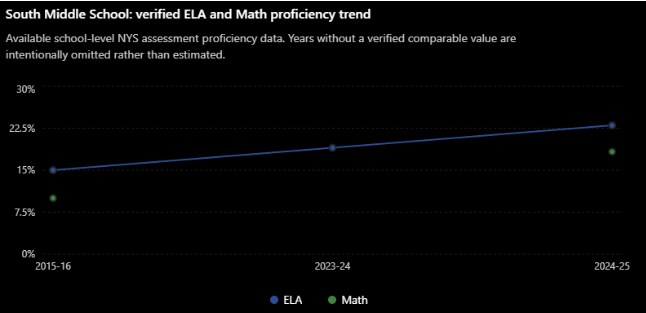
The most important finding is the duration of the performance issue. South's 2015–16 ELA and Math proficiency rates were already 15% and 10%, respectively. More than eight years later, the 2024–25 results were 23% ELA and 18.3% Math. ELA increased from 15% in 2015–16 to 23% in 2024–25, an 8-percentage-point increase. The 2024–25 grade-level results also move from 19% in Grade 6 to 26% in Grade 8.
The 2024–25 NYSED-based data show 18.3% of students proficient in Math, with Grade 6 at 10%, Grade 7 at 21%, and Grade 8 at 24%.
2015–16: ELA proficiency = 15%
2015–16: Math proficiency = 10%
2023–24: ELA proficiency = 19%
2024–25: ELA proficiency = 23%
2024–25: Math proficiency = 18.3%
2024–25: ELA proficiency by grade = 19% → 23% → 26%
2024–25: Math proficiency by grade = 10% → 21% → 24%
CSI history: South Middle School has been identified as CSI for more than 15 years
South Middle School’s assessment history reflects a longstanding pattern of academic need rather than a recent decline in performance. In 2015–16, only 15% of students were proficient in ELA and 10% were proficient in mathematics. These results established a low academic baseline well before the COVID-19 pandemic. Although the available data show some improvement over time, overall achievement has remained low. In 2023–24, ELA proficiency was approximately 19%, increasing to 23% in 2024–25. During the 2024–25 school year, mathematics proficiency was approximately 18%. Grade-level results also demonstrate that the challenge extends across the middle school: ELA proficiency increased from 19% in Grade 6 to 23% in Grade 7 and 26% in Grade 8, while mathematics increased from 10% in Grade 6 to 21% in Grade 7 and 24% in Grade 8. These results suggest that there are signs of student growth as students progress through the school, but overall proficiency remains low.
The assessment data should be viewed within the broader accountability history of South Middle School. The school has remained identified as a Comprehensive Support and Improvement (CSI) school for an extended period, with NECSD reporting that the school had been identified as CSI for more than 15 years. The Receivership designation therefore reflects a persistent pattern of performance across multiple accountability measures rather than a single test result or one year of low achievement. While ELA and mathematics assessments provide important evidence of student performance, NYSED’s accountability system also considers measures such as student growth, core subject performance, English language proficiency, and attendance.
The data point to a need for South Middle School to focus not only on increasing assessment proficiency but also on understanding the instructional and organizational conditions contributing to the long-term results. This includes examining the consistency of Tier 1 instruction, curriculum and vertical alignment, the rigor of classroom tasks and student work, intervention systems, attendance, and the use of data to identify and respond to student learning needs. The central question for the Receivership work should therefore move beyond whether scores are increasing and focus on whether the school is developing the systems, instructional practices, and data-driven cycles necessary to produce sustained improvement in student achievement. The available evidence shows that South Middle School has made some movement in achievement, particularly in ELA, but the level of performance remains low enough to require a sustained and coordinated school improvement effort.
To implement a school intervention plan or a Department-approved intervention model or comprehensive education plan, as applicable, a School Receiver may take the following actions consistent with the provisions of Education Law section 211-f and, with respect to issues related to such actions for which collective bargaining is required, consistent with any applicable collective bargaining agreement(s) and provisions of Article 14 of the Civil Service Law:
- Review and if necessary, expand, alter, or replace the curriculum and program offerings of the school, including the implementation of research-based early literacy programs, early interventions for struggling readers and the teaching of advanced placement courses or other rigorous nationally or internationally recognized courses, if the school does not already have such programs or courses.
- Replace teachers and administrators, including school leadership, who are not appropriately certified or licensed.
- Increase salaries of current or prospective teachers and administrators to attract and retain high-performing teachers and administrators.
- Establish steps to improve hiring, induction, teacher evaluation, professional development, teacher advancement, school culture and organizational structure (e.g., instructional coaches or research-based instructional plans). •
- Reallocate the uses of the existing budget of the school.
- Expand the school day or school year or both, which may include establishing partnerships with community-based organizations and youth development programs that offer appropriate programs and services in expanded learning time settings.
- For a school that offers first grade, add pre-kindergarten and full-day kindergarten classes if the school does not already have such classes.
- Include a provision of a job-embedded professional development for teachers at the school with an emphasis on strategies that involve teacher input and feedback.
- Establish a plan for professional development for administrators at the school, with an emphasis on strategies that develop leadership skills and use the principles of distributive leadership
- Order the conversion of a School under Receivership that has been designated pursuant to this section into a charter school; provided that such conversion shall be subject to Article 56 of the Education Law (including the requirement of a vote by parents of students attending the school) and that such conversion charter school shall operate pursuant to such article, and shall operate consistent with a Community Schools Model, and shall be subject to the provisions of subdivisions (3), (4), (5), (6), (9), (10), (11), (12) and (13) of Education Law section 211-f.
Under current NYSED rules, there is no fixed maximum number of years that a school can remain in Receivership. A school may enter Receivership after being identified as a Comprehensive Support and Improvement (CSI) school for at least three consecutive school years. Once in Receivership, the school remains in that status as long as it continues to meet the criteria for CSI identification. A school exits Receivership at the end of the school year in which it is no longer identified as CSI. Demonstrable Improvement (DI) does not automatically determine whether a school exits Receivership; rather, it affects whether the school remains under Superintendent Receivership or moves to Independent Receivership. Therefore, a school can remain in Receivership for many years if it continues to meet the applicable criteria.
A school exits Receivership by first exiting the Comprehensive Support and Improvement (CSI) support model. Demonstrable Improvement (DI) by itself does not remove a school from Receivership; rather, it demonstrates progress toward improvement. For a school under Superintendent Receivership, the school must no longer meet the CSI identification criteria and must exceed the Weighted Average Achievement Index (WAAI) or Core Subject Performance Index (CSPI) from the year the school entered Receivership. This must occur in the second school year following identification for Receivership or in any year thereafter. Once the school meets the applicable CSI exit requirements, NYSED removes the Receivership designation by June 30 of that school year. Therefore, a school may demonstrate improvement for multiple years and still remain in Receivership if it continues to meet the CSI criteria or has not met the required achievement-index measure.
For students and families, Receivership does not mean that students are being removed from their school or that the school is being closed. It means the school is receiving an increased level of state oversight, support, and intervention because NYSED has determined that the school has experienced persistent challenges with student outcomes. The goal is to improve the educational experience and outcomes for students by strengthening instruction, attendance, student engagement, school climate, and family partnerships.
IMPORTANT LINKS
NYSED Support Model Identifications | What you need to know
Receivership Planning and Supports | NYSED
IDENTIFICATION AND DI DETERMINATIONS
Office of Innovation and School Reform
Community Engagement Plan
Needs Assessment
Demonstrable Improvement Indicators
Quarterly Report 1
Quarterly Report 2
Quarterly Report 3
Quarterly Report 4
NYSED feedback or determination letters
Previous years’ plans and reports in an archive
PARENT FEEDBACK
Look for conversations with the principal events and if you have additional questions reach out to:
- Mr. William Morgan, Coordinator of Parent Involvement, 845-563-3414, wmorgan@necsd.net
PUBLIC EVENTS
Upcoming public events will be listed here and on the district calendar and homepage.
RESOURCES & SUPPORTS
- Academic intervention and tutoring
- Extended-day or Saturday programming
- Attendance supports
- Counseling and mental-health supports
- English learner and newcomer supports
- Special education and 504 contacts
- Transportation information
- Family workshops
- Community-school services
- After-school and enrichment programs
- Key school contacts
COMMUNITY TEAM (CET)
The Community Engagement Team (CET) is a representative body designed to foster and support public engagement. The CET serves as an active thought partner contributing to and supporting the development of recommendations for school improvement as outlined by the school and district.
The team members are also listed on this page and members are chosen through a transparent, collaborative process. Teachers are selected via internal union votes, parents are recruited with a focus on diverse student subgroups, students are selected across various diverse groups and grades to participate, and community partners are directly invited to ensure compliance with NYSED regulations. Additionally the receiver has included members of the bargaining units to participate in this process.
CET MEMBERS
- Dr. Jackie Manning Campbell - Superintendent of Schools
- Ms. Letitia Politi - Board of Education Member
- Ms. Onyx Peterson - Deputy Supt
- Dr. Elisa Correa-Soto - Assistant Superintendent
Mr. Joseph McGrath - Assistant SuperintendentMr. Roderick Phoenix - Principal
- Dr. Mariya Pushkantser - Director Middle Level
Ms. Aynek - Parent
- Mr. Joseph Beckner - Assistant Principal
Ms. Brenda Santiago-Sanchez- Parent - Dr. David Gallagher - Mt. St. Mary Faculty Ms. Erika Berrios - Assistant Principal
- Mr. Eric Buxton - Teacher
- Ms. Shamika Heyward - Parent
Skyler Chishol - Student Carmel Sesler - Student
- Mr. Salaam - Parent
- Mr. William Morgan - Parent Engagement Coordinator
ADDITIONAL INFORMATION
The following information is more in-depth and gives a detailed explanation of plans and procedures.
- Increase opportunities for students to explain their thinking and build on the ideas of their peers through structured academic discourse.
Who will do it?
- Grade-level team
- Building team
- District Team: Dr. Pushkantser (Director), Office of Curriculum & Instruction
Implementation, Progress Monitoring & Impact
| What will be done? | Who will do it? | Target Date |
|---|---|---|
| Professional Development: Facilitate specialized training for the ELA curricula and advanced "Building Thinking Classrooms" (BTC) discourse techniques. | Mr. Phoenix (Principal), Instructional Math Coach (Instructional Coach), with Dr. Pushkantser (Director of Middle Level) | August 2026 start then follow up monthly |
| Data Cycles: Analysis of student work samples and discourse to determine student instructional needs. | ELA and Math Department Teachers (facilitated by Math Coach and {Instructional Coaches) | Bi-weekly throughout the 2026-27 School Year |
| Audit and provide supplemental "thinking tools" (e.g., vertical non-permanent surfaces, discourse sentence starters) for all classrooms. | District Team: Office of Curriculum & Instruction (Director: Dr. Pushkantser) - confirmed by September 10, 2026 | September 30,2026 |
| lnter-rater Reliability: Conduct "Instructional Rounds" to ensure administrative feedback on discourse is consistent across all grade levels. Conduct these weekly classroom walks on a rotating basis. | Mr. Phoenix (Principal), Ms. Nin, Ms. Berrios Mr. Joseph and Ms. Reid (Assistant Principals), Dr. Pushkantser (Director) | September, then Weekly rotation |
| Curriculum & Resource Adoption -ELA Transition: Fully adopt and integrate ELA curricula" and data driven instructional decision making. | ELA Instructional Lead & Grade Level ELA Teachers (coached by Ms. Consorti (Instructional Coach), Dr. Pushkantser (Director) | September 2026 |
| Math Sustainability: Deepen Building Thinking Classroom practices through purposeful discussion that helps students make sense of and connect their learning. | Math Department Teachers, Math Coach (Instructional Coach, Math Lead), Dr. Pushkantser (Director) | Ongoing - 30-day check: October 27, 2026; 60-day check: November 26, 2026; 90-day check: January 27, 2027; Final Evaluation: June 12, 2027 |
Implementation Structures for Lead Strategy 1
| Structures Supporting Implementation | |
|---|---|
| Structure 1 Provide a one sentence description. |
Curriculum Monitoring Routines will be used to support literacy and numeracy classroom implementation with curricular resources. |
| When and how often will this take place? | A systematic observation and feedback loop designed to ensure literacy and numeracy standards and skills are taught using routines that maximize student voice. Addressed in weekly PLCs, daily walkthroughs, and weekly administrative cabinet meetings. |
| How will this be used to implement and monitor Lead Strategy 1? | Focus on increasing opportunities for students to explain their thinking and engage with peers through structured academic discourse. Administrators and instructional coaches will use a Discourse Look-For Checklist during daily walkthroughs to collect data on student and teacher talk. |
| Structure 2 Provide a one sentence description. |
Clear shared Expectation for High quality Instruction |
| When and how often will this take place? | A unified instructional framework that defines exactly what "High-Quality Academic Discourse" looks like across all content areas will be reinforced during Faculty Meetings, "The Weekly" memo, PLCs, and 1:1 coaching sessions and addressed in weekly PLCs, daily walkthroughs, and weekly admin cabinets. |
| How will this be used to implement and monitor Lead Strategy 1? | Faculty meetings, PLCs, grade-level team meetings, one-on-one conferences, and instructional coaching will be used to establish and refine schoolwide expectations for structured academic discourse. Teachers will engage in self-reflection using a shared rubric to analyze their practice, while instructional coaches provide actionable feedback focused on increasing student-to-student discourse and building on peers' ideas. |
Tol Improvement Plan: Progress Monitoring and Impact
| Aligned DIis | Data Sources | Early Progress Indicator(s) |
|---|---|---|
| - 3-8 Ela & Math All students MGP - Teacher Practices & Decisions - Curriculum Development & Support - 3-8 ELA and Math all core subject pi |
- iReady Diagnostic results 3x peryear - Formative Assessments-Reasoning Exit tickets - Formative assessments - Building Thinking Classroom rubric-based performance tasks-quarterly - Observational Data (Danielson Framework components 3b and 3C) |
Q1: ELA/Math teachers establish Thinking Classroom routines; lesson plans incorporate intentional "Talk Moves" and sentence frames. Q2: Students independently challenge or build on peer ideas; constructed responses show measurable growth in writing justifications. |
Resources
| Leader Resources (Instructional Coaches & Mentors) | Teacher Resources (High-Quality Curricula) | Student Resources (Adaptive Learning Platforms) |
|---|---|---|
| Analytic Dashboards (to self-monitor building-wide progress) | Protected Common Planning Time & Master Schedule to support PLCs | High-Quality Instructional Materials (Access to culturally relevant texts) |
| Data Walks & lntervisitation Cycles | Professional Development Funding (Directly aligned to Lead Strategy 1) | Student Data Folders & Binders (For self-monitoring and goal setting) |
| "Growth Essentials" Checklist (Principal-as-Instructional-Leader tool) and feedback tools | Summer Curriculum Intensives & Unit Internalization Guides | Hands-on opportunities for peer-to-peer learning |
| Professional development support | Thinking Classrooms PD (PD, coaching, and whiteboards) | Just-in-Time Tutoring |
| Quarterly Self-Reflection Rubrics | Lesson Study Cycles & Teacher lntervisitation Cycles | Extended Learning Opportunities (Summer Bridge & "Intersession Camps") |
| Data Innovation Suite (To review student work/compare strategies) | Shared Vocabulary Guides & Instructional Practice Anchors | Al Tutors & Personalized Learning Supports |
| Funding for to support field trips/real-world connections | Book Clubs (Professional learning communities focus) | Field Trips & Guest Speakers (Real-world connections) |
School Improvement Plan: Implementation
| What will be done? | Who will do it? | Target Date |
|---|---|---|
| Task Analysis PD: Train staff on Hess Cognitive Rigor Matrix and DOK levels to identify procedural vs. demanding tasks | Building Team: Instructional Math Coach (Instructional Coach), Mr. Phoenix (Principal), Dr. pushkantser (Director) | August 2026 / Sept 2026 |
| Resource Inventory: Audit core content units to build a grade-level "Bank of High-Demand Tasks" | Grade Level Team: Department Leads & Core Content Teachers, Dr. Pushkantser (Director), Mr. Phoenix (Principal) | By October 15,2026 |
| Provide professional development and collaborative planning to ensure alignment of rigorous learning objectives, lessons, and tasks that promote high-level thinking and grade-level expectations. | Dr. pushkantser (Director), Math Coach & Ms. Consorti (Instructional Coaches), Department Leads | September 2026 |
| Establish Thinking Routines: Implement "Thinking Classroom" structures to ensure students-not teachers-do the heavy lifting. | Mr. Phoenix (Principal), Instructional Math Coach (Coach), & Core Content Teachers | Ongoing (Baseline by Oct) |
| Implement Performance Tasks: Administer at least one high-cognitive demand performance task per quarter that requires a written justification of the solution. | Grade-Level Teams (facilitated by Department Leads under Math Coach & Ms. Consorti {Instructional Coaches) | Nov 2026, Jan 2027, March 2027 |
Structures Supporting Lead Strategy 2
| What structures will support Lead Strategy 2? | How does this compare to 2025-26? |
|---|---|
| Structure 1 Provide a one sentence description. Quarterly Performance tasks |
New x Refined |
| When and how often will this take place? Tasks administered 4x per year; Task and rubric analysis in department meetings, PLC's, and instructional rounds |
|
| How will this be used to implement and monitor Lead Strategy 2? An artifact analysis using a common rubric to examine student work for evidence of conceptual understanding, reasoning, and sense-making. |
|
| Structure 2 The ''ThinkinQClassroom" Observation & |
x New |
| When and how often will this take place? Bi-weekly coaching cycles and weekly administrative walkthroughs. |
|
| How will this be used to implement and monitor Lead Strategy 2? This structure will be used to monitor the routines that support Strategy 2. Success is measured by the percentage of classrooms where students engage in independent "productive struggle". |
School Improvement Plan: Progress Monitoring and Impact
| Aligned DIis | Data Sources | Early Progress Indicator(s) |
|---|---|---|
| - 3-8 ELA/Math MGP - Teacher practices - Curriculum support |
- Task Audit Logs: A monthly log of tasks analyzed using the rigor protocol. - i-Ready "Reasoning" and "Problem Solving" strands. - Student Work Samples: Rubric-scored performance tasks. |
- PLCs will use a common task-analysis protocol to revise and enhance at least two instructional tasks - Evidence of Impact: 70% of student work samples will demonstrate evidence of reasoning and sense-making, as measured by a common rubric |
Establish a schoolwide culture of connectedness and belonging-grounded in consistent routines, restorative practices, and authentic relationships-that reduces absenteeism, supports on-time arrival, and builds the perseverance students need for academic success and high school readiness.
School Improvement Plan: Progress Monitoring and Impact
| What will be done? | Who will do it? | Target Date |
|---|---|---|
| Establish a schoolwide focus on relationship building, goal setting, attendance monitoring system. | Building Team: Instructional coach (Instructional Coach), Mr. Phoenix (Principal), Restorative administrator- Ms. Reid, AP's- Mr. Joseph, Ms. Berrios, And Dr. pushkantser (Director) | August 2026 (PD Days) |
| Implement restorative practices training for all staff, including restorative circles, and conflict resolution protocols. | Building Team: Instructional coach (Instructional Coach), Mr. Phoenix (Principal), Restorative administrator- Ms. Reid, AP's- Mr. Joseph, Ms. Berrios, Ms. Nin, | By End of September |
| Launch a "Every Student Known by Name" initiative that ensures each student has a trusted adult advocate and receives regular check-ins. | Building and grade level teams: Principal Phoenix, AP's, restorative administrator, Department Leads & Core Content Teachers, Dr. Pushkantser (Director), Mr. Phoenix (Principal) | September 2026 |
| Implement positive attendance campaigns, grade-level incentives, and student recognition systems focused on attendance, orowth, and perseverance. | Building Team, Teachers, Student Support Staff | October 2026 and ongoing |
| Launch Vertical Non-Permanent Surfaces and digital tools (Class Companion/i-Readv) across 100% of core rooms. | Teachers & Building Team | September 2026 |
| Conduct monthly attendance and belonging data reviews to identify trends and adjust supports. | District Team & Building Team | Monthly starting October |
School Improvement Plan: Implementation
| What structures will support Lead Strategy 3? | How does this compare to 2025-26? |
|---|---|
| Structure 1 Provide a one sentence description. Student success team - A schoolwide structure that regularly reviews attendance, behavior, and academic data to identify students in need of support and coordinate targeted interventions that strengthen belonging, engagement, and persistence. |
☐ New x Refined |
| When and how often will this take place? Bi-weekly meetings with monthly grade-level data reviews throughout the school year. |
|
| How will this be used to implement and monitor Lead Strategy 3? The team will monitor attendance, tardiness, behavior referrals, course performance, and student engagement data to identify barriers to success and ensure timely interventions. Progress will be tracked through attendance trends, intervention logs, student surveys, and chronic absenteeism data. |
|
| Structure 2 Provide a one sentence description. Students participate in grade-level communities that promote school pride, relationship building, positive attendance habits, and perseverance through recoonition and team-based activities. |
☐ New x Refined |
| When and how often will this take place? Occurs monthly with ongoing incentives and celebrations. |
|
| How will this be used to implement and monitor Lead Strategy 3? The structure will reinforce students' sense of belonging and connection to school by recognizing attendance, growth, positive behavior, and perseverance. Implementation will be monitored through attendance data, participation rates in grade-level activities, student climate survey results, and absenteeism trends. |
Aligned DIIs & Indicators
| Alianed DIis | Data Sources | Early Progress lndicator(s) |
|---|---|---|
| - Early monitoring of attendance for all students - Climate and student engagement - Teacher practices - 3-8 ELA/Math MGP |
- Attendance - Student climate surveys - Behavior data - Referral data - Intervention logs - Participation records - Diagnostic and assessment data |
- Evidence of Change: An increase in attendance. - An increased percentage of students reporting feeling connected to at least one adult in the building. - Decrease in absenteeism compared to the same period the previous school year. - 65% of students participate in at least one school sponsored activity. - Q2: students with improved attendance will demonstrate increased academic progress on interim assessments. |
Implement an accessible communication system and build strong community partnerships that empower families as active partners in student success.
| What will be done? | Who will do it? | Target Date |
|---|---|---|
| Establish a unified schedule for school-to-home communication using Technology platforms | Building Team: Parent Liaison & Principal | August2026 (Launch) |
| Host quarterly parent workshops focused on district curriculum maps and home support. | Buildino Team- teachers and admin and director | Quarterly (Sept, Nov, Jan, March) |
| Parent Empowerment Services: Partner with local providers to support families. | District Team | Classes start Sept 2026; onQoinQ |
| Host "Open Lab" sessions during Curriculum Nights to help parents access real-time grade and attendance data. | Building Team & Data Specialist | September 2026 |
| Community Partnership - Codify community resource loops within the school structure. | District Tearn & Principal | October 2026 |
Implementation Structures
| What structures will support Lead Strategy 4? | |
|---|---|
| Structure 1 Provide a one sentence description. |
The "Multichannel Message" Hub -A dedicated system where all school communications are centralized, translated into the top five home languages, and delivered simultaneously via paper-based "Backpack Mail." |
| When and how often will this take place? | Monthly newsletters and weekly updates |
| How will this be used to implement and monitor Lead Strategy 4? | Integration of digital QR codes in communications to analyze parent survey feedback and interest trends |
| Structure 2 Provide a one sentence description. |
Monthly conversations with the principal with updates on school progress |
| When and how often will this take place? | Family Engagement Activity and /or workshops held monthly. |
| How will this be used to implement and monitor Lead Strategy 4? | Tracked via parent sign-in logs and unique participation metrics. |
Aligned DIIs & Indicators
| Aligned DIis | Data Sources | Early Progress lndicator(s) |
|---|---|---|
| - Family and Community engagement - EM attendance for all students - 3-8 ELA/Math MGP |
- Parent sign-in data, attendance logs, log ins, and feedback surveys | - Evidence of Change: A Increased parent participation at school-wide events compared to the 2025-26 baseline. - Q1 Benchmark: 50% of families will have successfully logged into Infinite Campus to check their student's attendance and grades at least once. - 02 Benchmark: 50% of parents will report that they agree" that the school provides clear information on how to support their child's learning at home. |
DIIs are the measurable benchmarks used by NYSED and districts to determine whether a receivership school has made sufficient progress.
| Indicator | Baseline | 2026–27 target | Current result | Status |
|---|---|---|---|---|
| ELA performance | ||||
| Mathematics performance | ||||
| Chronic absenteeism | ||||
| Student growth | ||||
| English-language progress | ||||
| School climate measure |
| Necessary Shifts in Practice | Why is this identified as a necessary shift in practice? Provide data and evidence. | Lead Strategy to address this necessary shift in practice. |
|---|---|---|
| Transition math instruction to prioritize reasoning and peer discussion | Staff/student surveys identify a critical lack of schoolwide rigor and classroom alignment. | Increase structured academic discourse to help students explain thinking and build on peer ideas |
| Transition from teacher-led procedural instruction to student-centered active engagement. | Students shared that they are bored in class; not all students felt they were being challenged. Data also showed a need to increase opportunities for discussion in classes and for project-based learning. | Engage students in cognitively demanding tasks that require reasoning, sense-making, and problem-solving SMS Definitions |
| Shift from high teacher scaffolding to real-time responsive instruction grounded in student thinking. | Historical data shows a severe "rigor gap": while 60% of students passed procedural classroom assignments, fewer than 28% achieved proficiency on State assessments due to an inability to solve multi-step, non-routine problems. 2025-26 baseline walkthroughs revealed teachers held the cognitive lift for over 70% of the instructional block, driving a culture of learned helplessness. | Establish a schoolwide culture of connectedness and belonging-grounded in consistent routines, restorative practices, and authentic relationships-that reduces absenteeism, supports on-time arrival, and builds the perseverance students need for academic success and high school readiness. Connection to culture connectedness and attendance |
| Shift family outreach from basic operational tracking to academic partnership. experiences) to build understanding of grade-level expectations and how families can support rigorous learninQ at home. | Family survey data and participation trends indicate a need for clearer communication around academic expectations so families can better support student learning and reinforce rigor outside of school. | Implement an accessible communication system and build community partnerships to empower families. |
